FAQ
Common questions about the platform and gene database fields,共 43 items。Click a question to expand the answer。
Genelibs is an online data analysis and mining platform developed by Jinan Honghui Bio-Tech. It enables high-throughput data analysis, database localization, and online data mining — a modern web-based analysis system.
Register via the Sign Up button on the platform. View / Register
The platform focuses on biological data querying, localization, processing, and visualization.
Registered users can use small-module analysis tools for free, covering basic analysis needs.
For large labs and research institutions, we offer customizable module suites with advanced features.
For personalized analysis projects, we provide custom development services tailored to your specific needs.
For large labs and research institutions, we offer customizable module suites with advanced features.
For personalized analysis projects, we provide custom development services tailored to your specific needs.
Absolutely. Through data customization or database search, you can find disease information and datasets, perform analysis, and get results to guide further experiments.
All analysis methods are well-established classic or novel approaches with published references, validated and tested.
Despite rigorous testing, bugs may still occur. If you encounter any errors, please report them to us and we will fix them promptly.
A gene symbol is the official abbreviation of a gene name. Human gene symbols are curated by the HUGO Gene Nomenclature Committee (HGNC), typically consisting of letters and numbers, e.g., TP53, BRCA1.
All platform modules use symbols as the primary gene identifier. On the gene detail page, you can also find previous symbols and aliases.
All platform modules use symbols as the primary gene identifier. On the gene detail page, you can also find previous symbols and aliases.
Classification by gene product and function: protein-coding gene; withdrawn; phenotype; pseudogene; non-coding RNA; other.
The gene identifier at the National Center for Biotechnology Information (NCBI).
Ensembl is a bioinformatics project for automatic annotation of eukaryotic genomes, jointly operated by the Sanger Institute and EBI.
RefSeq (Reference Sequence) is a non-redundant, curated collection of gene and protein sequences maintained by NCBI.
Locus type indicates the category of a gene locus. Values include: gene with protein product; withdrawn; phenotype only; pseudogene; RNA, misc; RNA, cluster (CRISPR RNA); RNA, small nuclear (snRNA); RNA, small cytoplasmic (scRNA); RNA, pseudogene; RNA, small nucleolar (snoRNA); RNA, long non-coding (lncRNA); RNA, Y; region; T cell receptor gene (TCR); T cell receptor pseudogene; RNA, transfer (tRNA); complex locus constituent; RNA, vault; virus integration site; endogenous retrovirus; RNA, micro (miRNA); protocadherin; immunoglobulin pseudogene; transposable element; fragile site; readthrough; RNA, ribosomal (rRNA); immunoglobulin gene.
Approved = officially accepted name; Entry Withdrawn = record has been removed.
The gene position on its chromosome. p = short arm, q = long arm. The number after p/q is the region; after the dot is the band. E.g., 9q21.3-q22 = chromosome 9, long arm, region 21, bands 3 to 22.
A brief description of the gene, with auto-generated Chinese translations.
A group of genes derived from a common ancestor through gene duplication, sharing structural and functional similarities.
UniProt (Universal Protein) is the most comprehensive protein database, integrating Swiss-Prot, TrEMBL, and PIR-PSD.
PubMed is a medical literature retrieval service. Sources include MEDLINE, OLDMEDLINE, in-process records, and publisher-supplied records.
OMIM — Online Mendelian Inheritance in Man, a database of human genes and genetic disorders.
miRBase is a comprehensive database providing miRNA sequence data, annotations, and predicted gene targets.
IMGT is the international reference database in immunogenetics, providing sequence and annotation data for immunoglobulins, T cell receptors, and MHC genes.
Long non-coding RNA (lncRNA) database. lncRNAs function through multiple mechanisms including genomic imprinting, chromatin remodeling, and translational regulation.
The nucleotide bases and their order that make up a gene. The gene detail page provides both genomic and transcript sequences for direct viewing and copying.
The gene expression module displays expression levels across tissues. Common terms: Major Tissues; Bone Marrow; Whole Blood; Brain; Heart; Liver; Lung; Kidney; Spleen; Stomach; etc. MicroArray; RNAseq; SAGE; BioGPS; intensity.
A primer is a short single-stranded DNA or RNA that serves as the starting point for DNA synthesis. DNA polymerase can only extend existing strands, not start new ones.
Cellular distribution: shows the location and distribution of the gene and its encoded protein within the cell.
Gene Ontology (GO) covers three aspects: Cellular Component; Molecular Function; Biological Process.
The platform integrates 5 interaction databases: STRING, BioGRID, IntAct, mentha, MINT, and Reactome.
MicroRNAs (miRNAs) are endogenous small RNAs of ~20-24 nucleotides with important regulatory roles. Each miRNA can target multiple genes, and vice versa. miRNAs are estimated to regulate one-third of human genes.
A gene pathway map illustrates gene family members and their interactions. KEGG and Reactome are the primary pathway databases used.
Diseases associated with abnormal gene function or variants that increase disease risk. Data sourced from BeFree, a text-mining tool for gene-disease associations.
The gene publications module collects published research papers related to the gene, sourced from PubMed and other public databases.
An open comment system where registered users can post comments on gene detail pages.
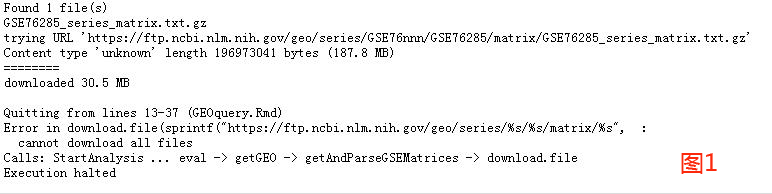
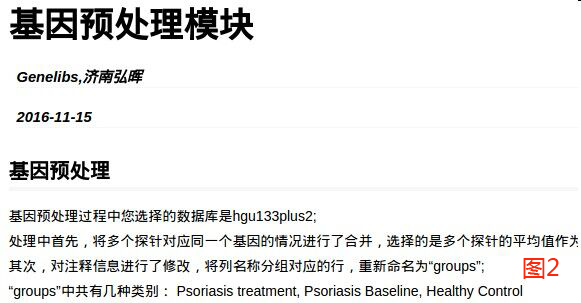
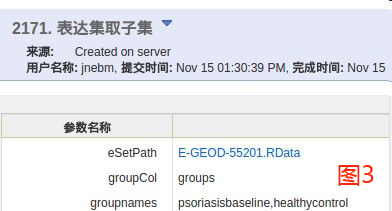
Cause: group name inconsistency (case/spaces).
Fix: ensure subset group names match.
Fix: use the Preprocessing module to convert. Upload RDATA, edit pDatamatrix.csv to fix group names, then regenerate RData.

Cause: incorrect miRNA name format — missing hsa prefix or misspelled as has.
Fix: use the correct format, e.g., hsa-miR-124